
About Dan McGann
Biography, the beliefs behind the work, the model Dan uses with clients, the handouts he gives them, and community resources in Peel.
To ask about an appointment: 416 970 2396 · dan@danmcganntherapy.com — or see the contact & office information on the home page.
Biography
Sitting down with Dan is a practical conversation. He'll want to understand what's been hard, what's already helping, and what a manageable next step might look like — and he tailors the work to the person in front of him.
Dan McGann earned his BA in Psychology from Wilfrid Laurier University in 1981 and his Master of Social Work from the University of Toronto in 1987. He has been a therapist ever since — nearly 40 years of clinical practice.
He began his career at Thistletown Regional Centre, then joined the Hospital for Sick Children, where his work included the Burns and Plastics program and adolescent psychiatry. In 1991 he moved to Credit Valley Hospital in Mississauga, spending 23 years in its Child and Family Clinic, and supervising graduate students and social work staff along the way.
In 2006, Dan founded the Teen Run Group Therapy Program at Credit Valley, combining running with group therapy for adolescents — a program that reflected his belief that change happens through the body as much as through talk. A lifelong runner himself, he has completed five marathons.
Dan began part-time private practice in 1992 and moved to full-time private practice in March 2013. His work has been recognized with a Paul Harris Fellowship and a Quality of Life Award (2011) from the Canadian College of Health Leaders. He is a member of the Ontario Association of Social Workers and the Ontario College of Social Workers and Social Service Workers.
Dan's own experience of recovering from depression informs the practical, hopeful way he works with clients.
Beliefs & Philosophy
Dan's work is practical and solution-focused. A few beliefs run through everything he does with clients:
- We create much of our reality. How we feel and function is shaped by our daily habits, our inner dialogue, and how we care for our bodies — and all three can change.
- Focus on the solution. Roughly 20% of the work is understanding the problem; 80% is building what comes next.
- Small steps, daily. Growing 1% a day beats waiting for a breakthrough.
- Thoughts are worth testing. Ask of a painful thought: "Is it true? Where's the evidence?" — and replace "Why me?" with "How can I?"
- Kindness works better than criticism. Self-kindness and forgiveness move people further than beating themselves up.
- Giving back and gratitude are part of mental health, not extras.
Dan draws on cognitive-behavioural therapy (CBT), solution-focused brief therapy, narrative and humanistic approaches, and — where they fit — EMDR, hypnosis and NLP. He tailors the approach to each client rather than fitting the client to a method. And he is straightforward about fit: within the first four to six sessions, he will tell you plainly whether he believes he can help — and if not, he will help you find someone who can.
"Do your best and life will do the rest."
You Create Your Reality
This is the diagram Dan uses with clients. Three areas of daily life shape how we feel and how we function — and each one is something we can work on. Creating a healthy structure and routine means lesser stress, due to an increased sense of control & predictability.
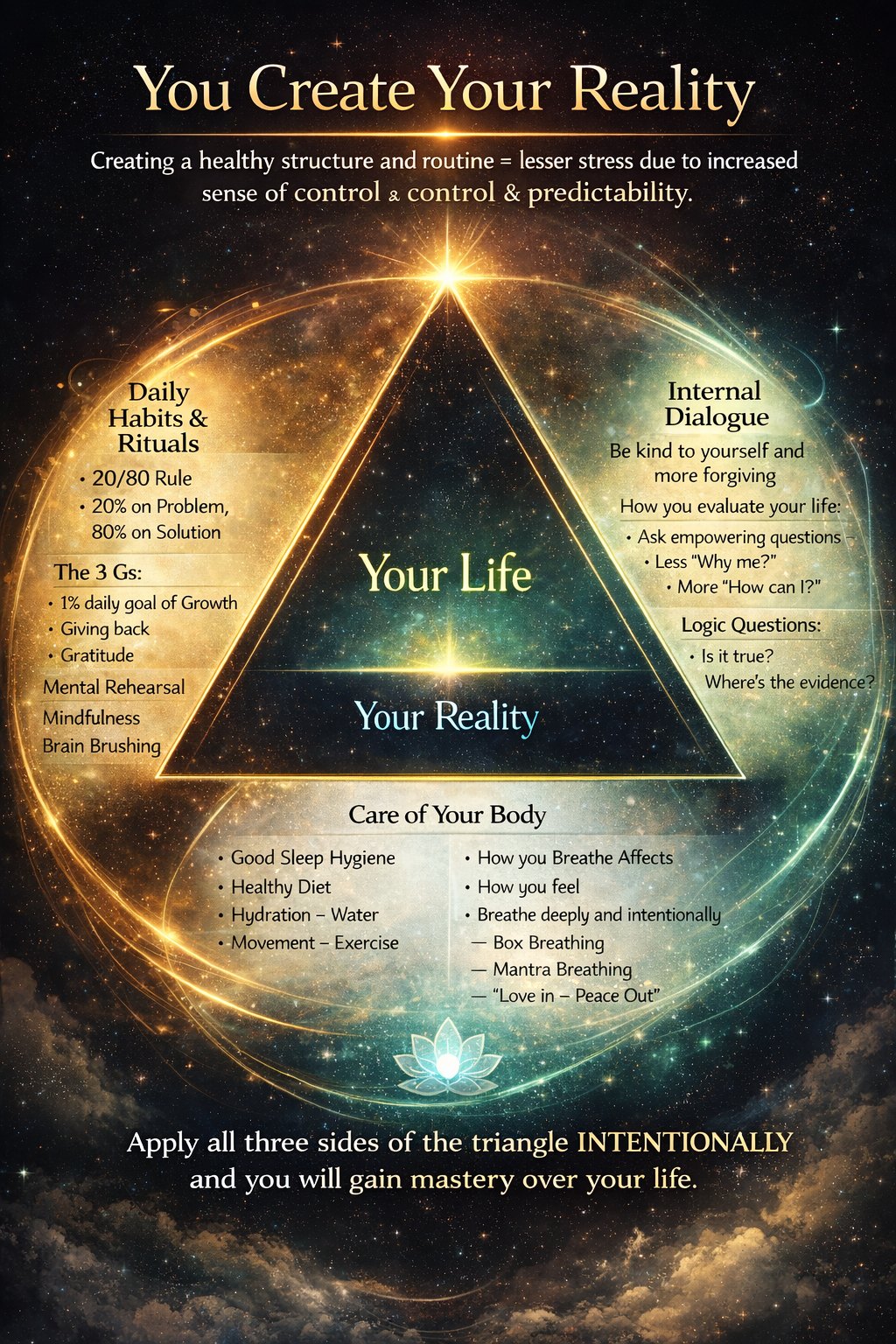
Daily Habits & Rituals
- 20/80 Rule: 20% on Problem, 80% on Solution
- The 3 Gs: 1% daily goal of Growth, Giving back, Gratitude
- Mental Rehearsal
- Mindfulness
- Brain Brushing
Internal Dialogue
- Be kind to yourself and more forgiving
- Ask empowering questions — less "Why me?", more "How can I?"
- Logic questions: Is it true? Where's the evidence?
Care of Your Body
- Good sleep hygiene, healthy diet, hydration — water, movement — exercise
- How you breathe affects how you feel: breathe deeply and intentionally — box breathing, mantra breathing, "Love in – Peace out"
Apply all three sides of the triangle intentionally and you will gain mastery over your life.
Handouts
These are the handouts Dan gives his clients. Each opens as a PDF you can read, save, or print.
- Daily Mental Hygiene Practice (PDF) — a daily practice built around the Brain Brush, the 20/80 rule, and setting your intention for the day: "Be more curious about the solution, not an expert on your problem."
- How to Feel Better (PDF) — simple, practical steps for lifting your state, one day at a time.
- Yesterday, Today and Tomorrow (PDF) — the classic reflection on living one day at a time.
- Letter Writing Exercise (PDF) — a three-letter exercise for processing loss and finding a way forward.
- Parent-Teen Weekly Check-In (PDF) — a weekly structure that helps parents and teens stay connected and address concerns before they become bigger problems.
- Solution-Focused Couples Therapy Questions (PDF) — questions that help couples picture their preferred future and notice what is already working.
Mental Health Community Resources — Peel
If you or someone you care about needs support now, these services are free and confidential.
Crisis lines (24/7)
- 9-8-8 Suicide Crisis Helpline — call or text 9-8-8, anywhere in Canada, English/French
- 24.7 Crisis Support Peel Dufferin (CMHA Peel + EveryMind) — 905-278-9036 or 1-888-811-2222. One number, all ages, in Peel; press 1 to reach an EveryMind youth crisis worker. Family members can call too.
- Kids Help Phone — 1-800-668-6868, or text CONNECT to 686868; live chat at kidshelpphone.ca. For youth up to about age 20.
- EveryMind youth crisis (under 18), direct — 416-410-8615
- Emergencies — call 911 or go to your nearest emergency department
Getting connected to services
- WhereToStart.ca — 905-451-4655 — the single intake for child and youth mental health services in Peel (EveryMind, AYSP, Rapport, Trillium and others)
- Family Services of Peel — 905-453-5775 (intake) — walk-in family counselling, free, for families in crisis
Housing
- Our Place Peel — 905-238-1383 — emergency youth shelter, ages 16–21, open 24 hours; 3579 Dixie Rd, Mississauga. Self-referral by phone; stays up to about 3 weeks, with crisis counselling and case management
- Peel Youth Village (SHIP) — 905-791-5576 — transitional housing, ages 16–24, stays up to 18 months; 99 Acorn Pl, Mississauga
Support for parents and families
- APSGO (Association of Parent Support Groups of Ontario) — 1-800-488-5666 — peer-led weekly groups for parents of difficult or disruptive teens, including Mississauga and Brampton chapters
- FAME (Family Association for Mental Health Everywhere) — family support groups in Mississauga and Brampton for families with a member living with mental illness; also groups for youth 13–17
- EveryMind parent/caregiver groups — free, in Peel, including an Emotion-Focused Family Therapy caregiver group; register through WhereToStart.ca (905-451-4655)